
A 4 drawer kitchen cabinets base unit is one of the most useful pieces of storage you can put into a kitchen — and one of the easiest to get wrong on paper. Four shallow, full-width drawers give you far better access than a door-and-shelf cabinet, but only if the widths, drawer heights and slide ratings match what you actually intend to store. This guide covers standard 4 drawer kitchen cabinet dimensions, how the four-drawer stack compares with three-drawer and door-based units, the hardware specifications worth paying for, and the measurements to send your supplier before you place an order.
What Is a 4 Drawer Kitchen Cabinet?
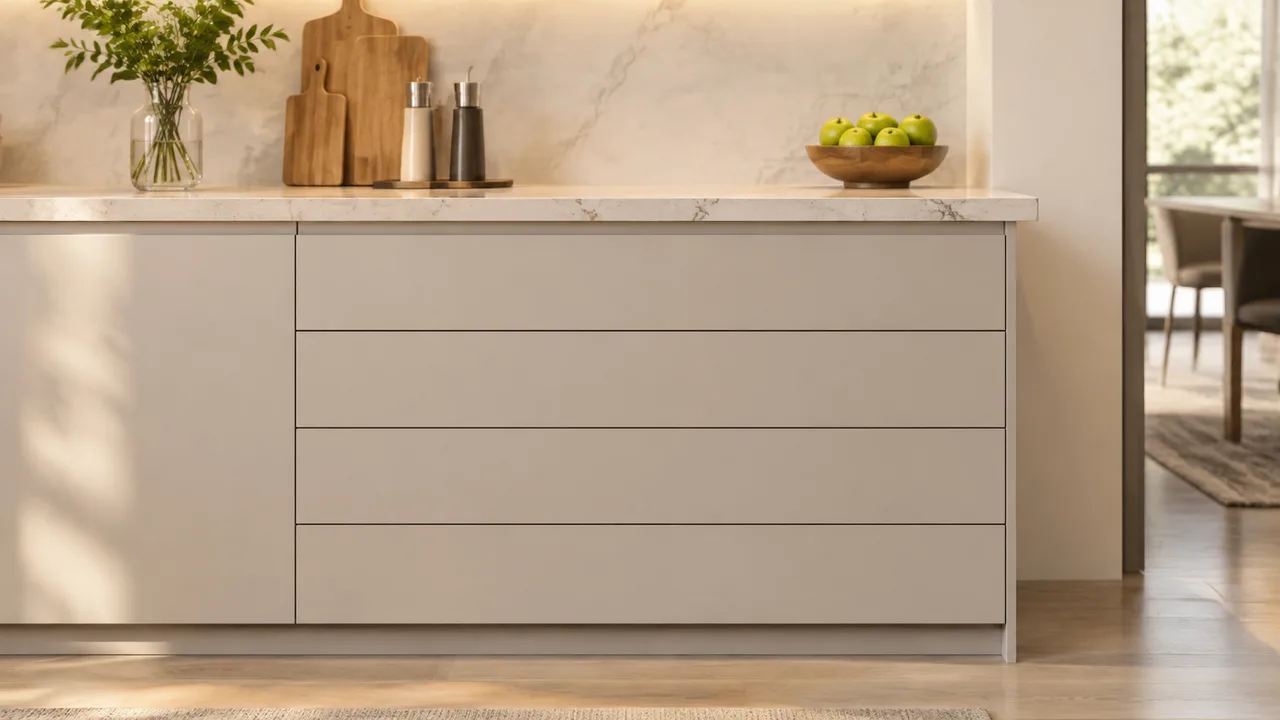
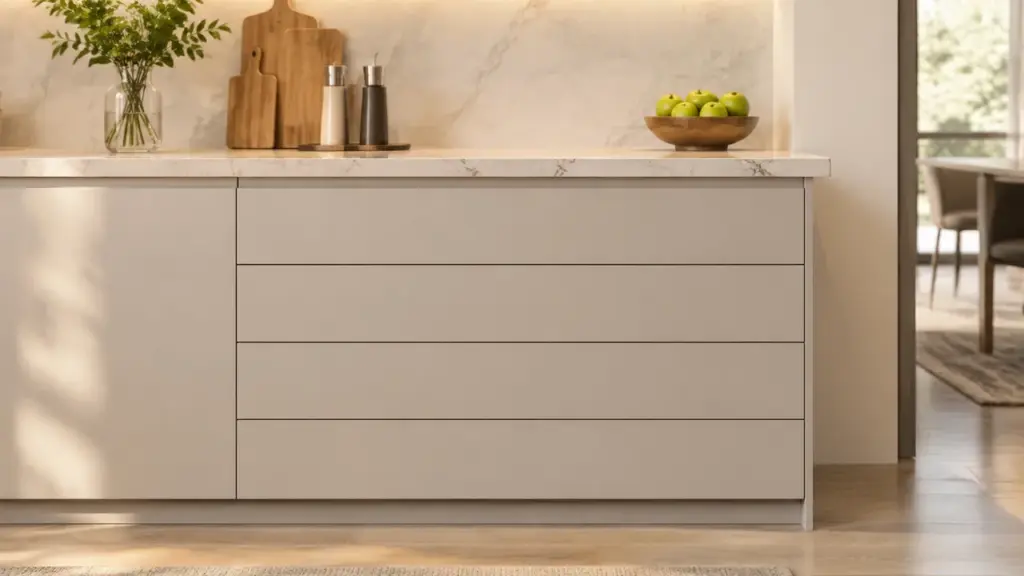
A four-drawer base cabinet is a floor-standing kitchen cabinet carcass with four horizontally stacked drawer fronts and no hinged doors. It sits on a recessed toe kick, supports the countertop, and is built to the same standard height and depth as every other base unit in the run so the worktop line stays continuous.
The appeal is ergonomic rather than decorative. With a door cabinet, anything stored at the back of a lower shelf requires kneeling and reaching into a dark cavity. A drawer brings the entire contents out into the light. That is why four-drawer stacks have become the default specification near prep zones and cooking stations, while door-based units are increasingly reserved for sinks, corner solutions and appliance housings. If you are comparing full kitchen layouts, our custom kitchen cabinet design and ordering guide explains how drawer bases fit into a wider cabinet plan.
Standard 4 Drawer Kitchen Cabinet Sizes
Most manufacturers work in 3-inch width increments. The figures below are the industry-standard nominal dimensions used across North American, Gulf and European export specifications; always confirm the millimetre equivalent with your factory before signing off a drawing.
| Nominal width | Usable interior | Typical placement | Notes |
|---|---|---|---|
| 12″ (305 mm) | ~10″ | Filler between appliances, narrow gap beside a range | Too narrow for standard cutlery trays; often used as a spice or tray pull-out |
| 15″ (381 mm) | ~13″ | Prep zone, beside a cooktop | Practical minimum for utensils and most organisers |
| 18″ (457 mm) | ~16″ | General prep, coffee station | Good balance of capacity and aisle clearance |
| 24″ (610 mm) | ~22″ | Main prep drawer, dishwasher-adjacent run | The most commonly ordered four-drawer width |
| 30″ (762 mm) | ~28″ | Long run under a continuous worktop | Requires heavier slides; check the load rating |
| 36″ (914 mm) | ~34″ | Island face, wide bank of drawers | Usually supplied as twin 18″ drawers rather than one wide box |
Other dimensions that should appear on every specification sheet:
- Depth — 24″ (610 mm) standard for base cabinets, with a 25″–25.5″ countertop overhang. Island and peninsula backs are often 12″–15″ deep.
- Carcass height — 34.5″ (876 mm), plus a 4″ (102 mm) toe kick recessed roughly 3″ (76 mm) from the front.
- Finished height — 36″ (914 mm) once the countertop is fitted, matching standard appliance heights.
- Drawer front heights — four equal fronts of roughly 6.5″–7″ each, or a graduated stack (for example 5″ / 6″ / 7″ / 9″) with the deepest drawer at the bottom for pots and small appliances.
- Reveals — typically 1/8″ (3 mm) between fronts. Full-overlay fronts need 1.5″–2″ filler strips at walls and corners to clear handles and adjacent doors.
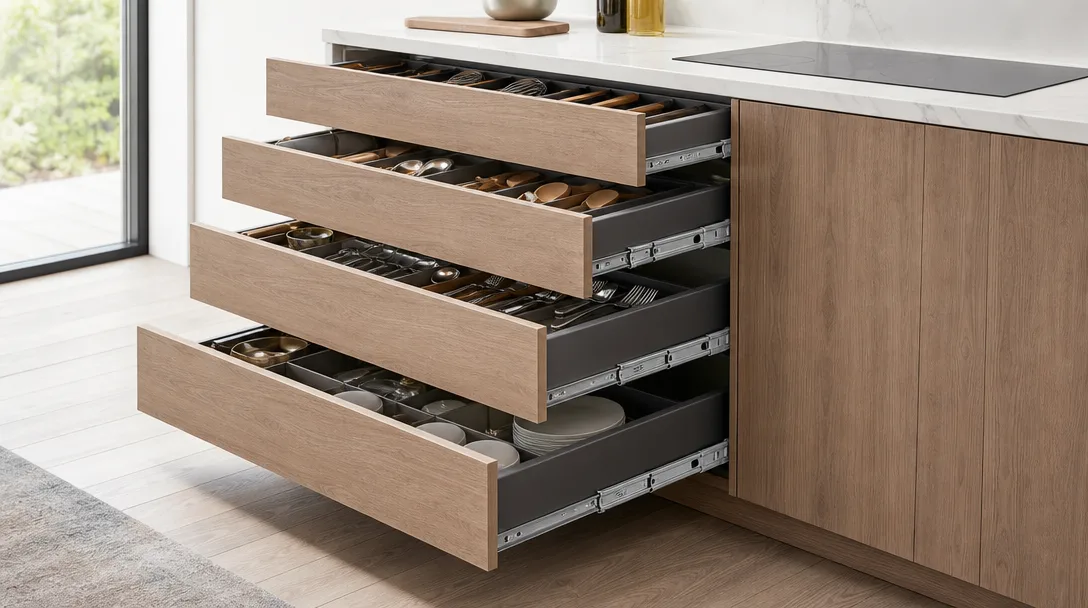
Graduated stacks are usually the better choice: a 9″ bottom drawer takes saucepans and mixing bowls, while the shallow top drawer handles cutlery. Four identical drawers look cleaner in a handleless design but waste vertical space on small items. For a comparison of how custom dimensions differ from stock sizes, see custom vs ready-made kitchen cabinets.
4 Drawer vs 3 Drawer vs Door-and-Drawer Bases
The right configuration depends on the height of what you store, not on the look of the front.
| Configuration | Drawer depth | Best for | Trade-off |
|---|---|---|---|
| 4 drawer stack | Shallow to medium (4″–9″ internal) | Cutlery, utensils, linens, spices, prep tools, small containers | Not enough clear height for tall pots, bottles or appliance bodies |
| 3 drawer stack | Medium to deep (7″–12″ internal) | Saucepans, storage containers, dishes, small appliances | Fewer sorting zones; small items get lost in deep drawers |
| Door + top drawer | One shallow drawer + full-height cavity | Sink bases, cleaning supplies, bulky trays, bin systems | Poor access to the back of the lower shelf |
| Drawer-within-drawer | Two tiers inside one deep front | Combining cutlery and deeper tools behind one front | Higher hardware cost and tighter tolerance |
A practical rule: assign the top two drawers to small, frequently used items and the bottom two to heavier cookware. If you need both, a drawer-within-drawer or a mixed three-plus-four run gives more flexibility than forcing every base into the same format.
Where 4 Drawer Kitchen Cabinets Work Best
- Beside the cooktop — utensils, oils and seasonings within arm’s reach while cooking.
- Primary prep zone — knives, boards, measuring tools and wrap dispensers, ideally directly opposite or adjacent to the sink.
- Island working face — a 30″ or 36″ four-drawer bank on the kitchen side of an island keeps the seating side uncluttered.
- Coffee or baking station — shallow drawers suit pods, filters, tins and small tins that disappear on a deep shelf.
- Butler’s pantry overflow — linens, serveware and table settings stay flat and visible.
Two places to avoid: directly under a sink (plumbing and a U-shaped trap make the drawers unusable without a custom cut-out) and anywhere a tall appliance body needs to sit. Also keep at least 36″ (915 mm) of clear aisle in front of a full-extension drawer bank — a fully open 24″ drawer projects roughly 20″ into the walkway. For upper-storage coordination, see choosing custom kitchen uppers.
Drawer Hardware Specifications to Check
The slide is the single biggest hidden cost in a drawer base, and the first thing to fail in daily use. Ask for these values explicitly rather than accepting “soft-close” as a description.
| Component | Recommended spec | Why it matters |
|---|---|---|
| Slide type | Full-extension, undermount, concealed, soft-close | Full extension exposes the whole drawer; undermount leaves the drawer box sides clean |
| Load rating | 35–45 kg (75–100 lb) dynamic for wide drawers | A 30″ drawer loaded with cast-iron cookware exceeds light-duty 25 kg slides |
| Cycle rating | 50,000+ open/close cycles tested | Proxy for long-term reliability in rental and hospitality projects |
| Drawer box | 15 mm (5/8″) plywood dovetail or dowel construction | Stapled MDF boxes swell and loosen in humid kitchens |
| Bottom panel | 12 mm (1/2″) minimum, fully captured in a groove | Thin hardboard bottoms bow under weight |
| Front adjustment | Tool-free height and side tilt clips | Allows reveals to be aligned after installation and settling |
| Side clearance | ~1/2″ (12 mm) per side for undermount slides | Determines the usable interior width quoted in the size table |
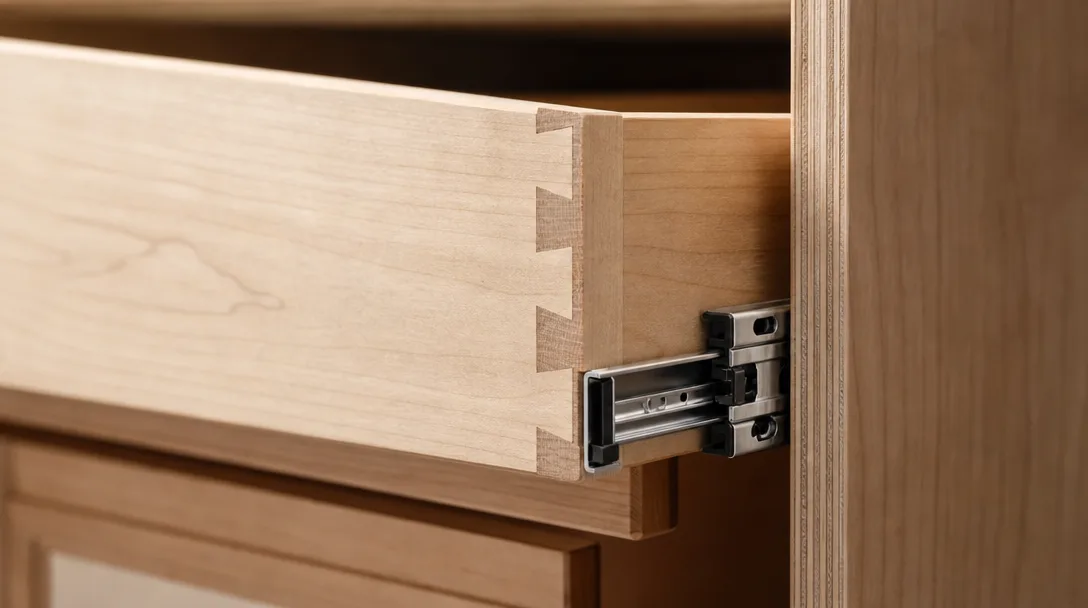
Reputable hardware brands publish their own load and cycle data; a factory that cannot name the slide series or supply a test certificate is usually quoting a light-duty component. When comparing quotes, this is the line item most worth upgrading — see the wholesale aluminium kitchen cabinet buying guide for how hardware grades affect landed cost.
Carcass Materials Compared
| Material | Strengths | Points to confirm | Typical use |
|---|---|---|---|
| MR / moisture-resistant plywood | Strong screw holding, stable in humidity, light | Formaldehyde class (E0/E1), core voids, edge banding | Humid climates, villa and hospitality projects |
| MFC / melamine chipboard | Cost-efficient, consistent finish, wide colour range | Board density, edge sealing at sink and floor contact | High-volume residential and developer units |
| Aluminium | Waterproof, no swelling, recyclable, insect-proof | Profile gauge, thermal/sound insulation, joinery detail | Coastal, high-humidity and outdoor kitchens |
| Solid wood / HMR MDF fronts | Premium painted or stained finish, repairable | Movement with seasonal humidity, paint system | Shaker and raised-panel fronts |
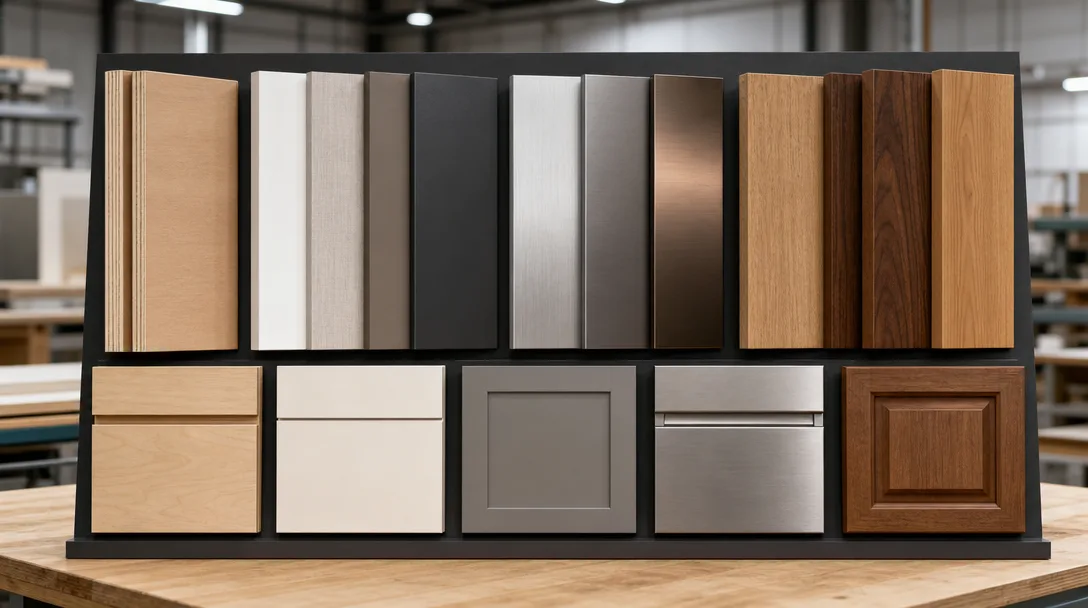
The carcass and the front do not have to be the same material. A common export specification pairs an MR-plywood box with HMR MDF painted fronts, which keeps the structure stable while allowing a crisp shaker profile. Our plywood vs MDF vs solid wood comparison covers the trade-offs in more detail, and the shaker vs flat-panel guide explains how the front profile changes the reveal and hardware choice.
How to Measure Before You Order
Most four-drawer cabinet problems are measurement problems, not manufacturing problems. Work through this list before sending a drawing:
- Measure at three heights — floor, 36″ and countertop level. Older walls are rarely parallel or plumb.
- Use the smallest dimension, then allocate 1.5″–3″ filler strips at each end and at inside corners.
- Confirm depth — 24″ carcass plus countertop overhang, and check that a fully open drawer will not hit an island, door or handle opposite.
- Map appliance clearances — a 24″ dishwasher, range or built-in oven needs its own bay; never assume a drawer bank can share it.
- Check the aisle — 36″ minimum in a working kitchen, 42″–48″ where two people cook or an island is involved.
- Verify the floor — note the high point and plan shims; an unlevelled run makes soft-close drawers drift open.
- Confirm finished height — 34.5″ carcass + toe kick + countertop = 36″ to match adjoining appliances.
- Send a dimensioned drawing, not just a list of widths: plan view, elevation, drawer-front split, hardware series and finish code.
For projects in the Gulf, also confirm that the specification aligns with local requirements on materials and documentation — the affordable kitchen cabinets in Riyadh guide covers regional sourcing considerations, while kitchen countertop materials and costs helps coordinate the worktop with the cabinet order.
Cost Drivers and Factory Ordering
Unit price alone tells you very little. Four things move the number:
- Hardware grade — a branded full-extension soft-close slide can add more per drawer than the whole carcass panel cost.
- Drawer box construction — dovetail plywood versus stapled MDF.
- Assembly format — flat-pack reduces freight volume; pre-assembled units reduce on-site labour but ship air.
- Custom widths and finishes — non-3″ increments, colour matching and special fronts carry tooling or minimum-order implications.
For distributors and project buyers, the economical route is usually to consolidate drawer bases with the rest of the cabinet run, countertops and other fit-out categories into one container. FenSo manufactures from a Foshan base — see the Foshan kitchen cabinet factory overview — and supports OEM sizes, finish matching and mixed-category consolidation. Market-level pricing context is in our 2026 kitchen cabinet market trends report.

Frequently Asked Questions
What exactly is a 4 drawer kitchen cabinet?
A standard-height base unit with four stacked full-width drawers and no doors, typically 24″ deep, 34.5″ high before the countertop, and available in widths from 12″ to 36″.
Are four-drawer bases available in standard sizes?
Yes. Most factories build them in 3″ increments from 12″ to 36″. Custom widths are possible through OEM programs but usually require a drawing and a minimum quantity.
How much weight can a kitchen drawer hold?
A good undermount full-extension slide is rated for 35–45 kg in dynamic use. Confirm the rating for the widest drawer in your order, not just the smallest.
Are drawers better than doors in a base cabinet?
For anything you reach for often, yes — the whole contents come to you. Doors still make sense at sinks, corners and for tall or bulky items.
Can I install a four-drawer cabinet under the sink?
Not without a custom cut-out for the trap and supply lines. A sink base with a false drawer front and tilt-out tray is the usual solution.
Why do some searches say “kitchen cabnets”?
It is simply a common misspelling of “kitchen cabinets”. Search engines normally correct it automatically, but when comparing quotes or supplier catalogues, make sure the spelling difference has not led you to a different product category or specification.
Can I order custom drawer heights?
Yes. Graduated stacks (for example 5″ / 6″ / 7″ / 9″) are a standard OEM option; specify the front split on the elevation drawing so the reveals remain even.
Whether you need a single 24″ four-drawer base or a full container of kitchen cabinets for a development, the specification is what protects the result: correct widths, a graduated drawer split, rated slides and a dimensioned drawing. Explore the custom cabinet ordering guide for the full process, or contact our team for drawings, samples and a consolidated quote.


 English
 German
 Chinese
 Arabic
 French
 Spanish
 Turkish
 Russian
 Italian