The kitchen is where Saudi hospitality actually happens — the coffee, the dates, the extra chairs pulled in at Eid. Riyadh homeowners and project buyers both want that room to function and look right without paying showroom markups that have nothing to do with the cabinet itself. This guide is built around a practical question: in 2026, what does “affordable” actually mean for kitchen cabinets in Riyadh, and which procurement route gets you there without sacrificing the things that fail first — hinges, board grade, and dimensional fit?
The Three Real Procurement Routes in Riyadh
1. Al-Kharj Road and the industrial showrooms
Al-Kharj Road remains the densest concentration of kitchen manufacturers and showrooms in Riyadh, particularly around Al Sulay and the industrial exits, with dozens of independent workshops and factory showrooms competing on price and material variety. The advantage is physical: you can touch the aluminum profile, compare hinge weight, and negotiate face to face. The risk is that quoted “per-meter” prices rarely include countertop, installation, or VAT, so the number on the business card and the number on the final invoice can diverge by 20–30%.
2. Haraj and the secondhand market
Haraj and similar classified platforms regularly list used cabinets, often from expats leaving the country or villas undergoing full renovations. For a rental apartment or a tight renovation budget, a clean used set with new soft-close hinges can look and function nearly new. The hidden cost is fit: standard used modules rarely match non-standard wall lengths, and hauling plus modification can erase the savings. Inspect the sink base first — moisture damage at the bottom panel is the single most common reason a used cabinet is on the market.
3. Local showroom vs. factory-direct
A local showroom sells speed and a physical sample. A factory-direct route — particularly from Foshan, China’s integrated cabinetry cluster — sells custom dimensions, OEM color matching, and a lower unit cost at project volumes, at the price of a 6–10 week production and shipping window. Neither is universally “cheaper.” The affordable choice depends on whether your constraint is time or unit cost.
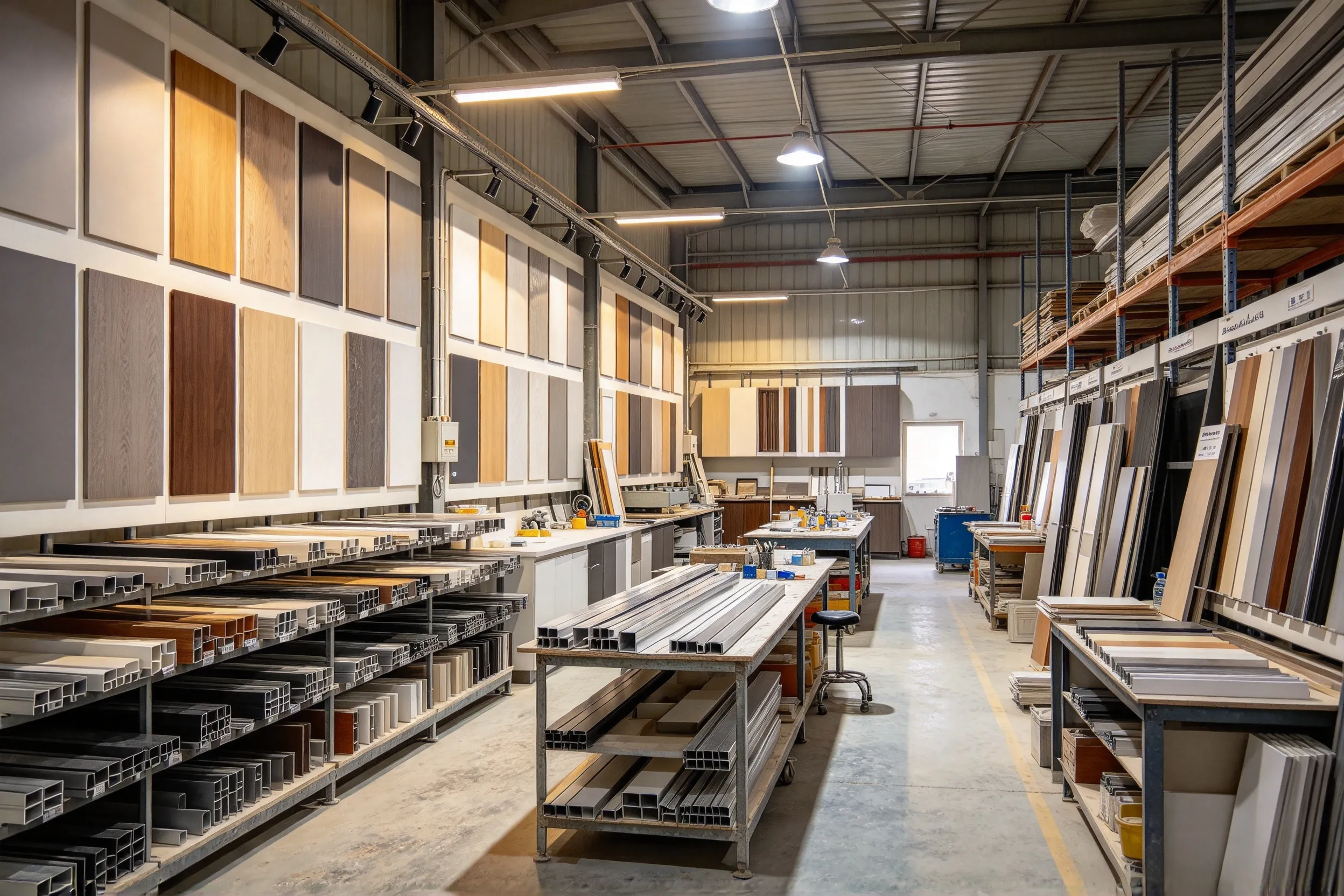
What Actually Drives the Price per Linear Meter in Riyadh
A quote of 650 SAR and a quote of 2,200 SAR can both be labeled “aluminum kitchen cabinets.” The gap is almost never the aluminum alone. Local 2026 price ranges for custom kitchens — carcass, door fronts, and installation included, countertop excluded — sit roughly as follows:
| Material / finish | Indicative range (SAR / linear meter) | What pushes you to the top of the range |
|---|---|---|
| Aluminum / Alumetal | 900–1,400 | Profile thickness, heavy-duty drawer runners, hydraulic hinges |
| Poly-lacquer on MDF | 1,000–1,800 | Original vs. copy hardware, gloss level, color consistency |
| Wood / MDF with laminate or veneer | 1,300–2,400 | Core board grade, edge-banding quality, visible-face finish |
| 亚克力 | 1,400–2,600 | Sheet thickness, scratch resistance, seamless edge bonding |
| Baked lacquer / HPL | 1,500–2,600 | Number of coats, curing control, HPL brand and thickness |
Source: Riyadh 2026 custom-kitchen price tables, updated July 2026.
Cheaper entry points exist — aluminum single-fiber or Formica-faced modular units from around 650–1,000 SAR per meter — but they usually sit at the bottom of the hardware and board-grade spectrum.
Three variables explain most of the spread:
① Board grade, not just “MDF vs. plywood.” For a Riyadh kitchen that sees humidity spikes and occasional sink-area splashes, the relevant specification is MR (moisture-resistant) MDF or MR plywood, not standard interior board. MR MDF uses a melamine-modified resin that cuts 24-hour thickness swelling from roughly 25–35% (standard MDF) down to 8–12%. It is designed for wet-atmosphere use — cabinet carcasses, doors, bathroom vanities — but it is not waterproof; the under-sink cabinet floor should be plywood or marine ply, and prolonged standing water will still cause swelling and delamination.
② Hardware grade. Soft-close hinges and drawer runners are the first components to fail in a hot, high-use kitchen. A cabinet that “feels” solid in the showroom but uses unbranded hinges will need replacement within three years — a cost that wipes out the initial saving.
③ Scope inclusion. Confirm whether the per-meter price includes installation and countertop. Riyadh installation alone can run 500–1,500 SAR depending on kitchen size and complexity, and many Al-Kharj Road shops include free installation only above a certain meterage. Compare quotes on the same scope or the comparison is meaningless.
Where Factory-Direct Fits — and Where It Doesn’t
The structural reason a local showroom charges more is not mysterious: rent, floor stock, and the margin of an intermediary between you and the factory. Factory-direct sourcing from Foshan removes that layer and adds two things a showroom cannot easily match: custom dimensions (non-standard wall lengths, appliance niches, ceiling-height uppers) and OEM color matching against a developer’s RAL or Pantone reference.
The economics work best when you are filling volume. A 40HQ container holds roughly 12–18 medium flat-pack kitchens, and ocean freight from South China to Jeddah or Dammam runs approximately 1,200–2,000 USD for a 20ft container and 1,800–3,500 USD for a 40ft, with transit times of 18–25 days. For a single apartment kitchen, the freight and documentation overhead can erase the factory-price advantage. For a villa project, a batch of apartments, or a mixed container that also carries bathroom vanities and flooring, the per-unit logistics cost drops sharply and the custom-fit benefit compounds.

The honest trade-off: factory-direct is a project calendar decision, not an emergency replacement decision. If you need cabinets installed this month, a local Al-Kharj Road workshop is the rational route. If you have a 6–10 week runway and a defined layout, factory-direct gives you more control over board grade, hardware brand, and finish matching than a showroom stock program.
FenSo大楼 operates from the Foshan cluster and builds its kitchen cabinet line around this exact split: MR plywood for wet-zone carcasses, aluminum for heat and moisture resistance, and MFC for dry-zone economy, all available with soft-close hardware, custom sizing, and OEM color matching. If your project also includes bathroom vanities or flooring, those can be consolidated into the same container to spread the freight cost.

The Cabinet Configurations That Fit a Riyadh Kitchen
Most affordable-kitchen failures come from specifying the right material for the wrong zone. A practical FenSo kitchen spec splits the room into three exposure bands:
Wet zone (sink base, dishwasher surround): MR plywood carcass with a moisture-tolerant edge seal. Avoid standard MDF or HDF here regardless of price.
Heat and humidity zone (full-run base cabinets, tall units near the cooking line): aluminum frame or aluminum-clad carcass, which tolerates the temperature swings and occasional dust ingress without warping. Aluminum is the local default for a reason, but the profile thickness matters more than the label — thin single-fiber aluminum at the low end of the price table will dent and rack sooner than a heavier section.
Dry zone (upper cabinets, pantry, display shelving): MFC or MR MDF with a heat-resistant laminate or HPL face. This is where you recover budget without putting the cabinet at risk — upper units see far less moisture and mechanical load than the base run.
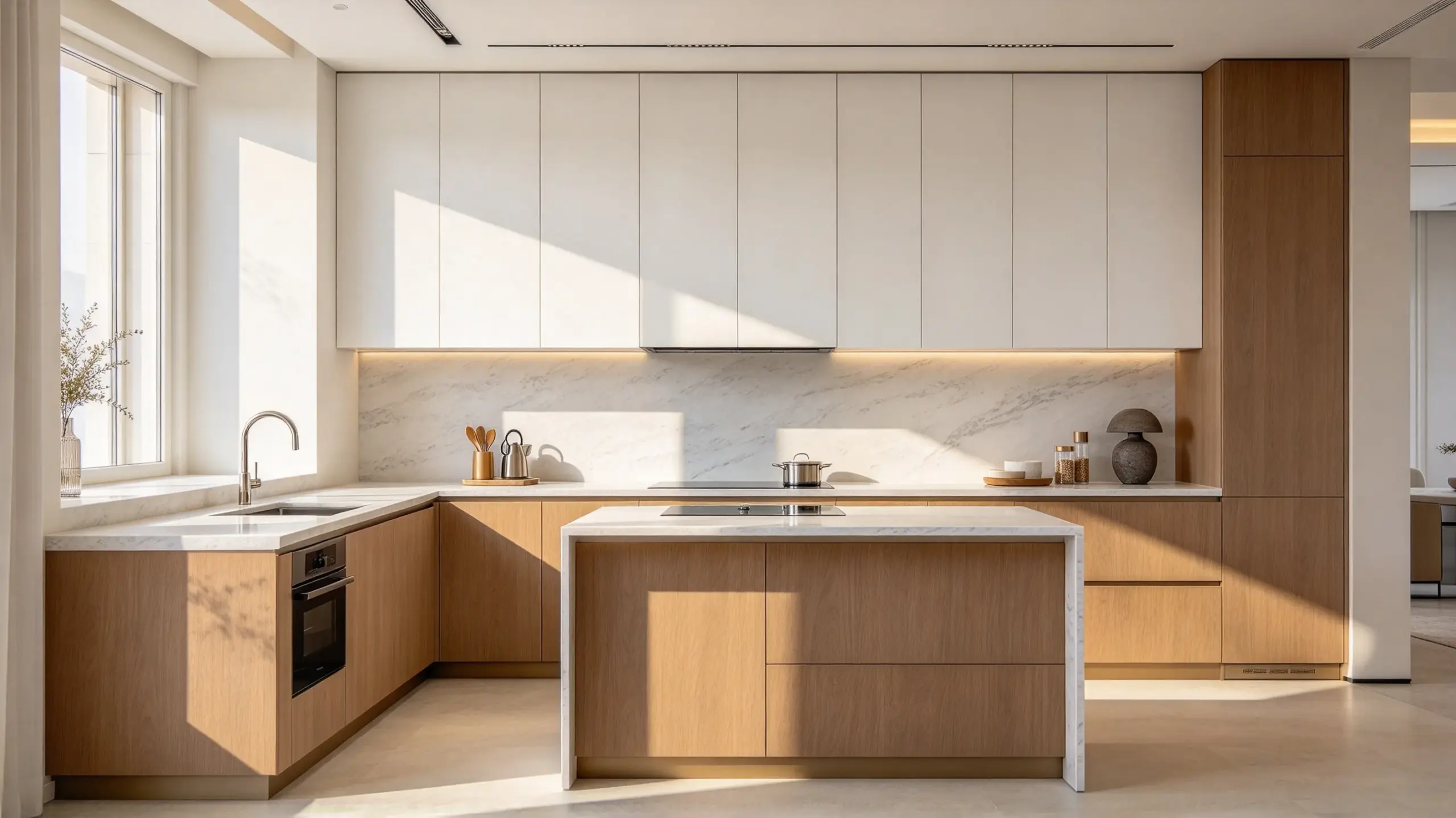
For style, the cost-neutral levers are handleless flat fronts, two-tone (dark base / light upper), and a matte finish that hides dust better than high gloss. The cost-adding levers are curved profiles, integrated LED routing, and gloss lacquer — beautiful, but usually the first items to cut if the brief is genuinely “affordable.”
Project fit: FenSo’s cabinet modules are sized for villa kitchens, apartment batches, and serviced-apartment fit-outs. If you send a measured layout with wall lengths, appliance positions, and preferred door style, the factory can return a dimensioned quote and a finish sample reference within 48 hours. For buyers who need to see and touch a door before committing, a physical sample can be shipped ahead of the container order.
The Riyadh Import Checklist: SASO, SABER, and the Things That Hold a Container
If you are importing rather than buying locally, compliance is not optional and it is not something to solve after the container sails. Kitchen cabinets are regulated products in Saudi Arabia, and wooden furniture falls under SABER conformity assessment. Since 1 October 2025, a 发货证明(SC) is mandatory for every imported shipment before customs declaration, and the product model must match an approved 产品证书(PC) on the SABER platform.
The cabinet-specific checks that matter at the factory gate:
- Formaldehyde emission: wood-based panels must meet the applicable SASO limit; require board rated E1 at minimum and keep the test report on file. This is the most common documentation gap at Jeddah and Dammam.
- 模型标识符: the shipped materials, dimensions, and finish must match the certified PC exactly. A “similar” door color or a substituted board grade is a rejection risk, not a cost saving.
- Arabic labeling and HS code alignment: commercial invoice, packing list, PC, and customs declaration must point to one HS code (generally the 9403 furniture family, duty around 5%, plus 15% VAT on imported value).
- Export packing for sea transit: cardboard corners, foam edges, and desiccant. Gloss fronts scratch at port handling; quartz countertops should ship vertically in A-frame racks if included.
FenSo prepares export packing, model-to-PC alignment, and the SABER paperwork trail as part of the order, so the container clears rather than queues.
The Bottom Line
“Affordable” in Riyadh’s 2026 cabinet market is not a single number per meter. It is the combination of the right board grade for each zone, hardware that survives year three, a procurement route that matches your project timeline, and a compliance file that does not stop the container. A local Al-Kharj Road workshop wins on speed. A factory-direct container wins on custom fit and unit cost — provided you plan the 6–10 week window and build SASO/SABER into the quote from the start.
If you are pricing a villa kitchen, an apartment batch, or a mixed container, send your layout and door-style direction to FenSo for a factory-direct quote and a material sample reference. The cheapest cabinet is the one you do not have to replace in two summers.