
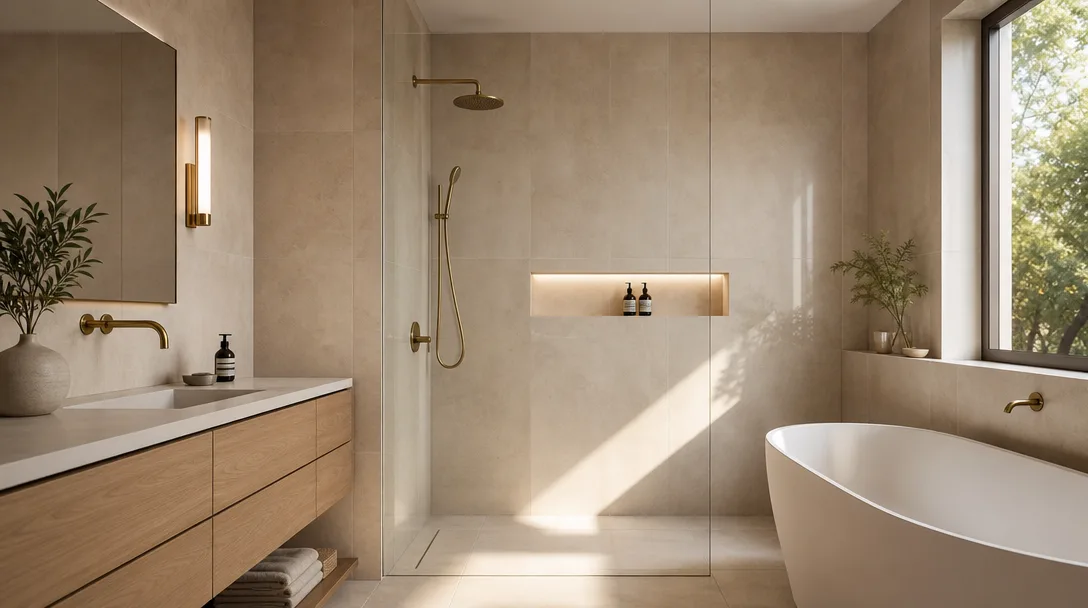
Bathroom projects use 12 types of tile, grouped into four families: ceramic, porcelain, natural stone, and glass or mosaic. For dry interior walls, a 12″ × 24″ glazed ceramic is enough. For a shower floor you need rectified porcelain rated R10 or higher. Choosing on looks alone, without checking water absorption and slip resistance, is the single most common reason bathrooms get redone in Latin America.
This guide sorts the 12 options by how they actually behave on site: absorption, durability, size, price per square meter, and where each one belongs. At the end you will find the three decision paths we use with contractors on projects from 4 to 40 bathrooms.
How many types of bathroom tile are there?
Twelve, when grouped by material and format. The table below is the fast view; the detail on each one follows.
| النوع | امتصاص الماء | Typical bathroom use | Price (USD/m²) | Weak point |
|---|---|---|---|---|
| Glazed ceramic | 3–10% | Dry walls | 4–9 | Not for wet floors |
| الخزف | < 0.5% | Floor and wall | 9–20 | Needs diamond blade |
| Glazed stoneware | 0.5–3% | Residential floor | 7–14 | Less durable than porcelain |
| Rectified porcelain | < 0.5% | Premium floors, thin joints | 14–28 | Demands a perfectly level substrate |
| Glass mosaic | < 0.5% | Shower, niches, curves | 15–40 | High labor per m² |
| Stone-look tile | 1–6% | Feature walls | 10–22 | Deep texture traps soap |
| Natural marble | 0.2–2% | Wall, vanity top | 35–90 | Acid-sensitive, stains |
| الجرانيت | < 0.5% | Floor, countertop | 25–60 | Heavy, hard to cut |
| Slate | 1–4% | Shower, rustic floor | 18–40 | Chips at the edges |
| Glass tile | < 0.5% | Wall, backsplash | 20–50 | Shows water spots |
| Hexagon | 3–8% | Decorative floor | 12–30 | Many joints, more upkeep |
| Large format (48″ × 96″) | < 0.5% | Continuous walls | 25–60 | Two installers required |
Azulejo, baldosa, ceramic and porcelain: what the words actually mean
In Latin America the same product carries different names by country, and that breaks more budgets than any technical issue. Clarify the vocabulary with your supplier before quoting:
- Azulejo: glazed wall tile. In Argentina and Uruguay it refers almost exclusively to vertical cladding.
- Baldosa / loseta: floor tile. In Mexico and Central America, “loseta” is the standard trade term.
- Cerámico: in Argentina and Chile, any fired clay tile including floor tile. It does not imply lower quality.
- Porcelanato: tile with absorption under 0.5%, fired at higher temperature. This is the term you will see in Brazilian, Colombian and Peruvian catalogs.
The same product can ship as “porcelain tile” on a Chinese invoice, “porcelanato” in a Brazilian catalog, and “cerámica rectificada” in a Mexican hardware store. Once the order is written with the technical datasheet attached, the name stops mattering.
The 12 types, one by one
1. Glazed ceramic wall tile
The baseline bathroom option: red or white body with a vitrified glaze. It absorbs 3–10% water, so it needs waterproofing behind it in wet zones. Its advantage is price and design variety; its limit is that it takes neither foot traffic nor constant moisture. Use it on dry walls, well outside the direct shower area.
2. Porcelain
Homogeneous body, absorption under 0.5%, high mechanical strength. It is the only material that solves floor and wall with the same piece, which simplifies both purchasing and cutting. In family bathrooms it is the default choice; in commercial work it is mandatory where traffic is high.
3. Glazed stoneware
The midpoint between ceramic and porcelain: 0.5–3% absorption, durable glaze, moderate price. It works well on residential bathroom floors with light traffic. Do not specify it for hotel corridors or gyms: it wears through faster.
4. Rectified porcelain
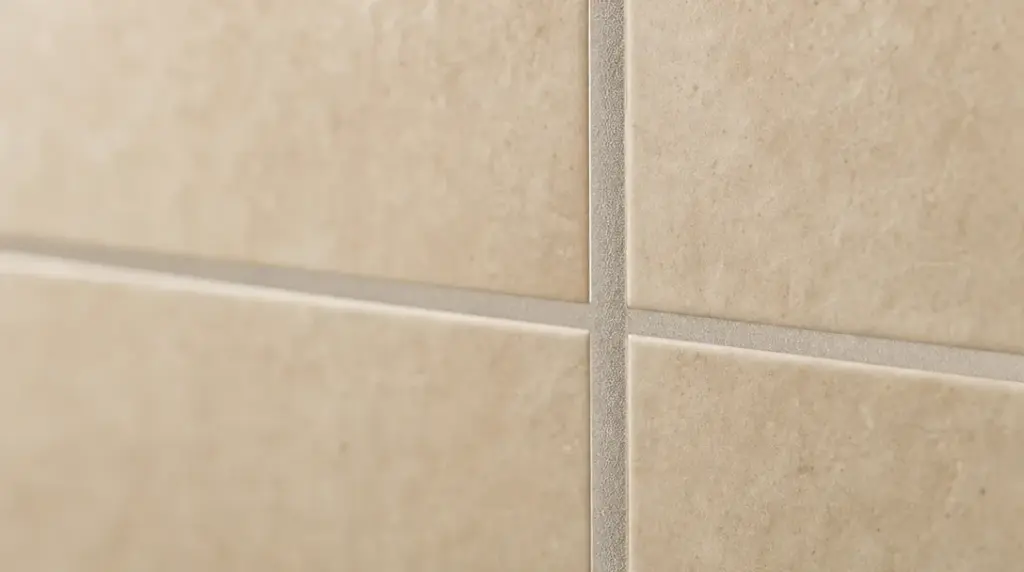
Edges are cut square after firing, so tiles meet with a 1–2 mm joint. The result is an almost continuous surface, much in demand in modern bathrooms. The trade-off: any unevenness in the substrate is magnified, and installation requires laser leveling.
5. Glass mosaic
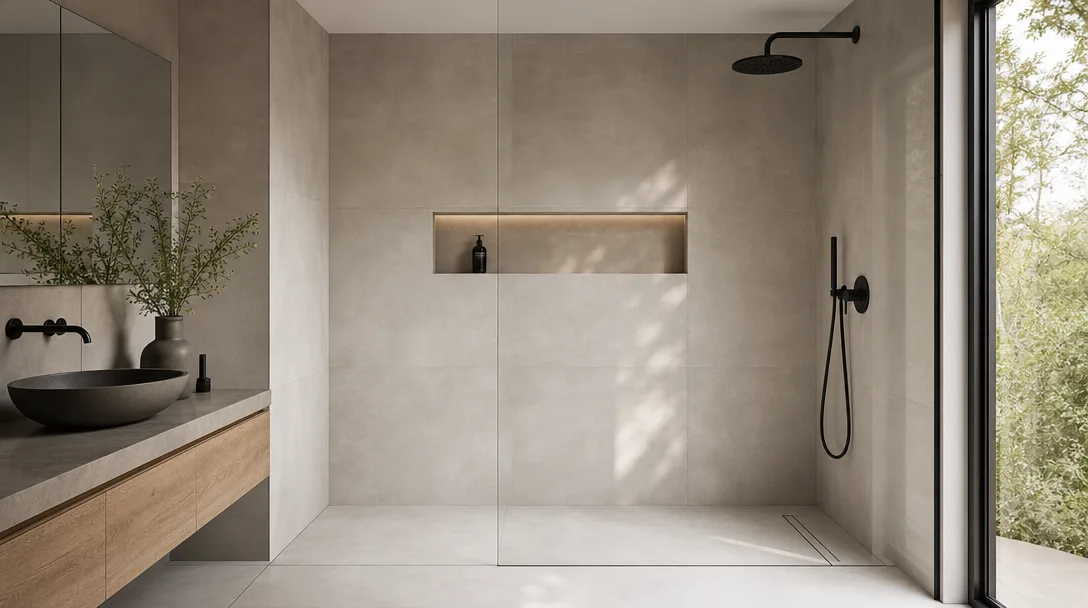
Pieces from 1″ × 1″ to 2″ × 2″ on a mesh backing. Its reason to exist is geometric: it follows curves, niches, shower benches and linear drains without visible cuts. It also adds traction through joint density. It is the correct answer for a shower floor where large format cannot hold the slope.
6. Stone-look tile
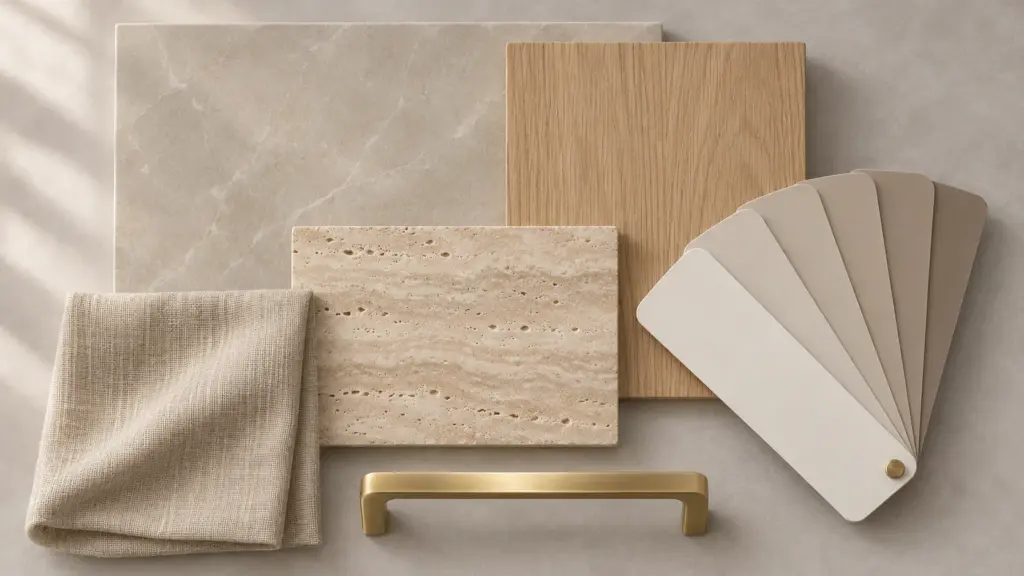
Ceramic or porcelain with a glaze that imitates travertine, limestone or concrete. It delivers the stone look without the stone maintenance. Choose a matte finish: deep reliefs collect soap and limescale in the shower.
7. Natural marble
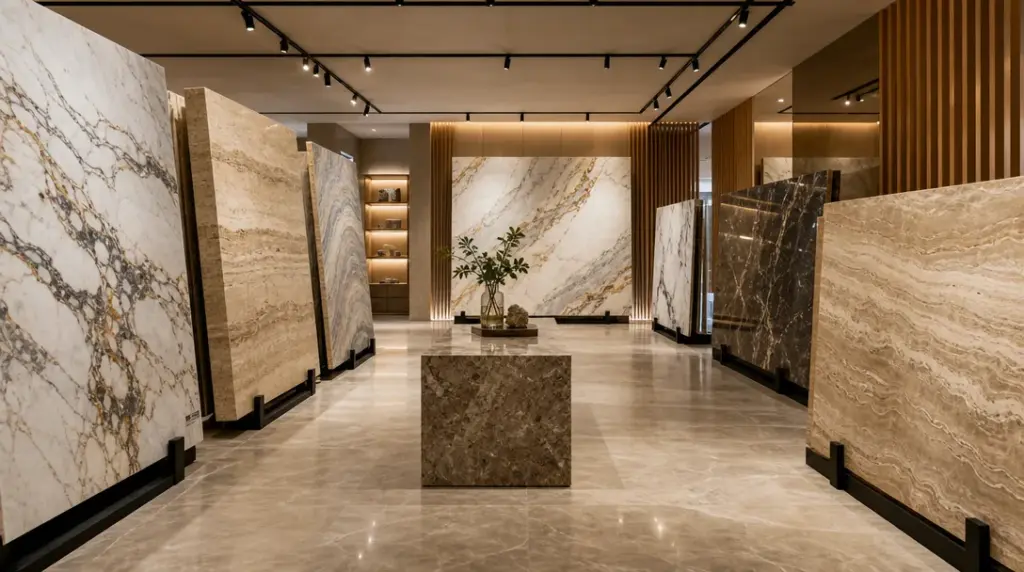
Metamorphic stone, low absorption but acid-sensitive. In bathrooms it belongs on walls, vanity tops and shelves, not on the shower floor: it etches and stains with ordinary cleaners. It needs sealing every 12–18 months. If the client wants marble on the floor, propose marble-look porcelain and remove the problem.
8. Granite
Igneous stone, effectively impermeable and highly abrasion-resistant. It goes on high-traffic floors and vanity tops. Its weight, around 2.7 kg per m² per centimeter of thickness, means checking the structure on upper floors.
9. Slate
Metamorphic stone with a natural cleft face and good wet traction. It is the rustic option for colonial or mountain-style showers. Edges chip easily in transit, so order 10% overage.
10. Glass tile
Tempered glass panels or tesserae. They bring light into small bathrooms without windows. Excellent on walls, unsuitable on floors. In splash zones, choose a satin finish so water spots do not show.
11. Hexagon
A fashionable format, available in ceramic and porcelain. The appeal is visual; the real cost is in installation, since joint density adds 30–50% more labor than an equivalent square format. Use it in guest bathrooms or as a floor accent, not across the entire surface on a tight budget.
12. Large format (48″ × 96″ and up)
Porcelain slabs up to 63″ × 126″. They remove nearly all joints, which in a bathroom means fewer dirt lines and an immediate sense of space. They require two installers, suction cups, and a substrate flat within 2 mm over 2 m. In hotel projects they are now the luxury standard.
Standard sizes and how many square meters to buy
| Size (in) | Size (cm) | Where it performs | ملاحظة |
|---|---|---|---|
| 8″ × 8″ | 20 × 20 | Small bathroom floors, mosaic | Many joints, more upkeep |
| 12″ × 12″ | 30 × 30 | Guest bathroom floors | Classic budget format |
| 12″ × 24″ | 30 × 60 | Walls, compact bathrooms | Best-selling wall size in the region |
| 18″ × 18″ | 45 × 45 | Residential floors | Good price-to-area ratio |
| 24″ × 24″ | 60 × 60 | Floor and wall, family bathroom | The safest balance |
| 24″ × 48″ | 60 × 120 | Walls, elongated bathrooms | Visually lengthens the room |
| 36″ × 36″ | 90 × 90 | Large floors | Needs a room of 4 m² or more |
| 48″ × 96″ | 120 × 240 | Continuous walls, showers | Two installers mandatory |
To calculate the order: multiply length by width for each surface and add them up. Then add 8% waste for straight lay and 12–15% for diagonal layouts, many corners, or large format. In bathrooms with niches and benches, go to 15% without hesitation: the wasted cut on a 48″ × 96″ slab costs more than the square meter itself.
Slip resistance: what you need on floor, shower and exterior
The European DIN 51130 classification assigns R ratings based on the slope at which a shod person slips. It is the reference used in technical specifications across the region.
| Class | Traction level | Where specified |
|---|---|---|
| R9 | Basic | Walls, bedrooms, dry zones |
| R10 | متوسط | General bathroom floor, kitchen |
| R11 | مرتفع | Shower floor, locker rooms |
| R12 | مرتفع جدًّا | Ramps, industrial zones |
| R13 | Maximum | Areas with grease or waste |
The United States uses a different parameter: DCOF ≥ 0.42 wet (ANSI A326.3). If the supplier only provides the American datasheet, ask for the wet DCOF value; below 0.42 the tile should not go on a shower floor. The Tile Council of North America publishes the equivalence table between both systems.
Rule of thumb for bathrooms: R10 on the general floor, R11 inside the shower tray. With elderly people or small children in the house, raise the entire surface to R11. The premium is 5–10% and it removes the leading cause of domestic accidents in bathrooms.
Prices per square meter in 2027
| المستوى | المواد | Price (USD/m²) | Who buys it |
|---|---|---|---|
| الميزانية | Glazed ceramic 12″ × 24″ | 4–9 | Social housing, fast renovation |
| وسط | Porcelain 24″ × 24″ | 9–20 | Family homes, apartments |
| Upper-mid | Rectified porcelain 24″ × 48″ | 14–28 | Premium finish projects |
| مرتفع | Large format 48″ × 96″ | 25–60 | Hotels, showrooms |
| حجر | Marble, granite, slate | 25–90 | Author projects, feature walls |
Installed cost usually runs 1.8 to 2.5 times the material price, covering adhesive, waterproofing, grout, labor and cuts. A porcelain at USD 15/m² ends at USD 32–38/m² installed in most Latin American capitals. If the bathroom includes a shower tray, read our shower enclosure and tray guide first, because the floor format drives the slope and drain position.
How to choose for your bathroom
Small bathroom (under 43 sq ft / 4 m²)
Large format on walls, 24″ × 48″ or 36″ × 36″, with a thin joint and a light color. Fewer joints means less visual noise and a sense of space. On the floor, the same material in 24″ × 24″ at R10.
Main family bathroom
Rectified porcelain 24″ × 24″ on the floor and 24″ × 48″ on walls. It is the combination with the best ratio of durability, availability and price on the Latin American market. Add glass mosaic only in the shower tray.
Wet or coastal zone
Porcelain under 0.5% absorption with epoxy grout, not cementitious. Epoxy costs three times as much, but it is the only thing that survives salinity and hypochlorite cleaning without disintegrating in two years.
Five mistakes that force a redo
- Buying wall tile for the floor. No slip rating, and it becomes an ice rink when wet.
- Calculating without waste. The 8% is not a sales margin: it is the real percentage of pieces that break or get cut wrong.
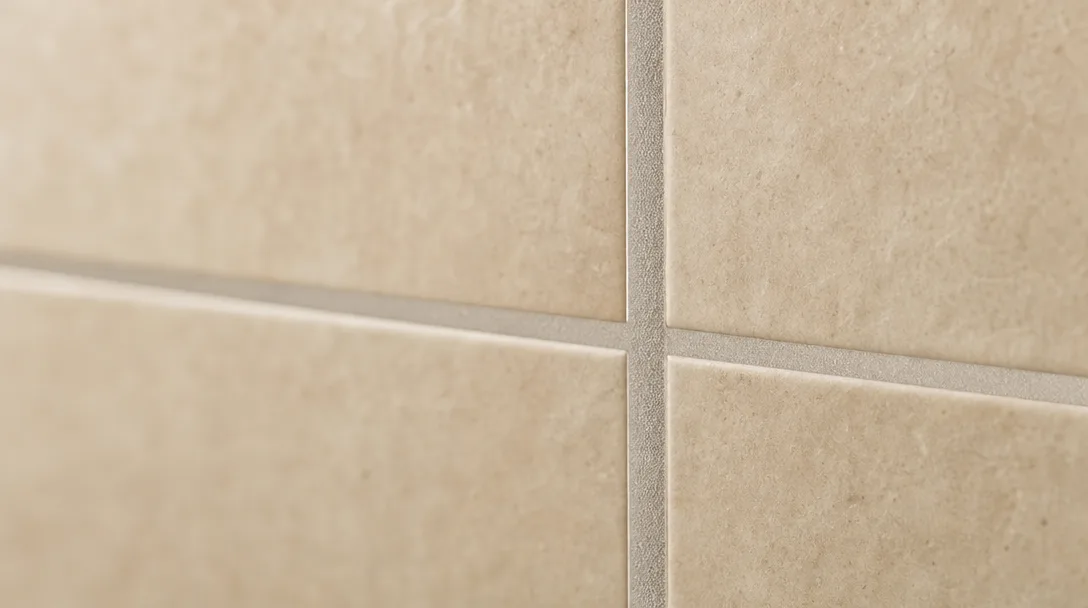
- Rectified tile on an uneven substrate. A 1 mm joint forgives nothing; the unevenness shows as a shadow across the whole wall.
- Cementitious grout in the shower. It degrades with soap and black mold appears within 18 months.
- Not checking caliber and shade of the batch. Two pallets of the same model can differ by a full shade. Require the entire bathroom to come from one batch.
الأسئلة الشائعة
What is the difference between azulejo and baldosa?
Azulejo is made for walls, usually with a decorative glaze and medium absorption. Baldosa or loseta is made for floors and carries slip-resistance and abrasion ratings. Using one for the other is the most common and most expensive mistake to fix.
What tile is best for a bathroom?
Porcelain under 0.5% absorption, 24″ × 24″ on the floor at R10 and 24″ × 48″ on walls. It is the material with the best balance of price, durability and availability in the region.
How many square meters do I need for a 54 sq ft bathroom?
With walls clad to 8 ft, a 6.5 × 8 ft bathroom needs 190–225 sq ft of wall plus 54 sq ft of floor. Add 10% waste: buy 270–310 sq ft total.
What does PEI mean on a tile?
It is the surface abrasion resistance scale, from I to V. Walls: PEI I–II. Residential floors: PEI III–IV. Commercial or heavy traffic: PEI V. A PEI III in a hotel lobby wears out in under three years.
What slip rating do I need in a shower?
R11 minimum, or wet DCOF of 0.42 or higher. In showers with a steep slope and linear drain, R11 is the standard most hotel specifications require.
Can I use large format tile in a small bathroom?
Yes, and it is usually the best decision. A 48″ × 96″ slab on a 5 ft wall creates a single vertical joint, which visually enlarges the room. The requirement is that the slab can get up the stairs or elevator.
How much does it cost to tile a 54 sq ft bathroom?
With mid-range porcelain: 280–310 sq ft of material at USD 12–18/m² runs USD 310–520. Installation with waterproofing and epoxy grout adds USD 500–800. Total: USD 800–1,300 per bathroom, excluding fixtures and faucets.
Porcelain or ceramic for bathroom walls?
If budget rules, glazed ceramic. If the wall takes constant splashing, or the project is a rental with high tenant turnover, porcelain: the price difference is recovered in the first renovation you do not have to do.
Buying bathroom tile wholesale for your project?
We work with distributors, contractors and architecture studios that need full lots at a consistent caliber and shade, with datasheets and breaking-strength certification. If you are specifying a multi-bathroom project, review our flooring and cladding line or write to us through the contact page with sizes and estimated volume: we return an FOB quote and a physical sample within 5 working days.
You may also need our toilet parts guide وـ sanitary ware and bathroom accessories line to complete the order in a single container.
Related articles
- Porcelain vs ceramic: buying guide
- Best waterproof flooring for bathrooms
- Bathroom design and renovation ideas 2026
- What is a toilet? Parts and how it works
- Flooring and cladding line (wholesale)
Sources and standards
Technical references used for the classifications, sizes and requirements cited in this guide.
- ASCER — Spanish Ceramic Tile Manufacturers Association: portal.ascer.es
- Tile Council of North America (TCNA) — installation methods and ANSI A326.3: tcnatile.com
- DIN 51130 — slip resistance classification (R9–R13): dinmedia.de
- ICONTEC — Colombian technical standards for ceramics and finishes: icontec.org
 English
 German
 Chinese
 Arabic
 French
 Spanish
 Turkish
 Russian
 Italian