
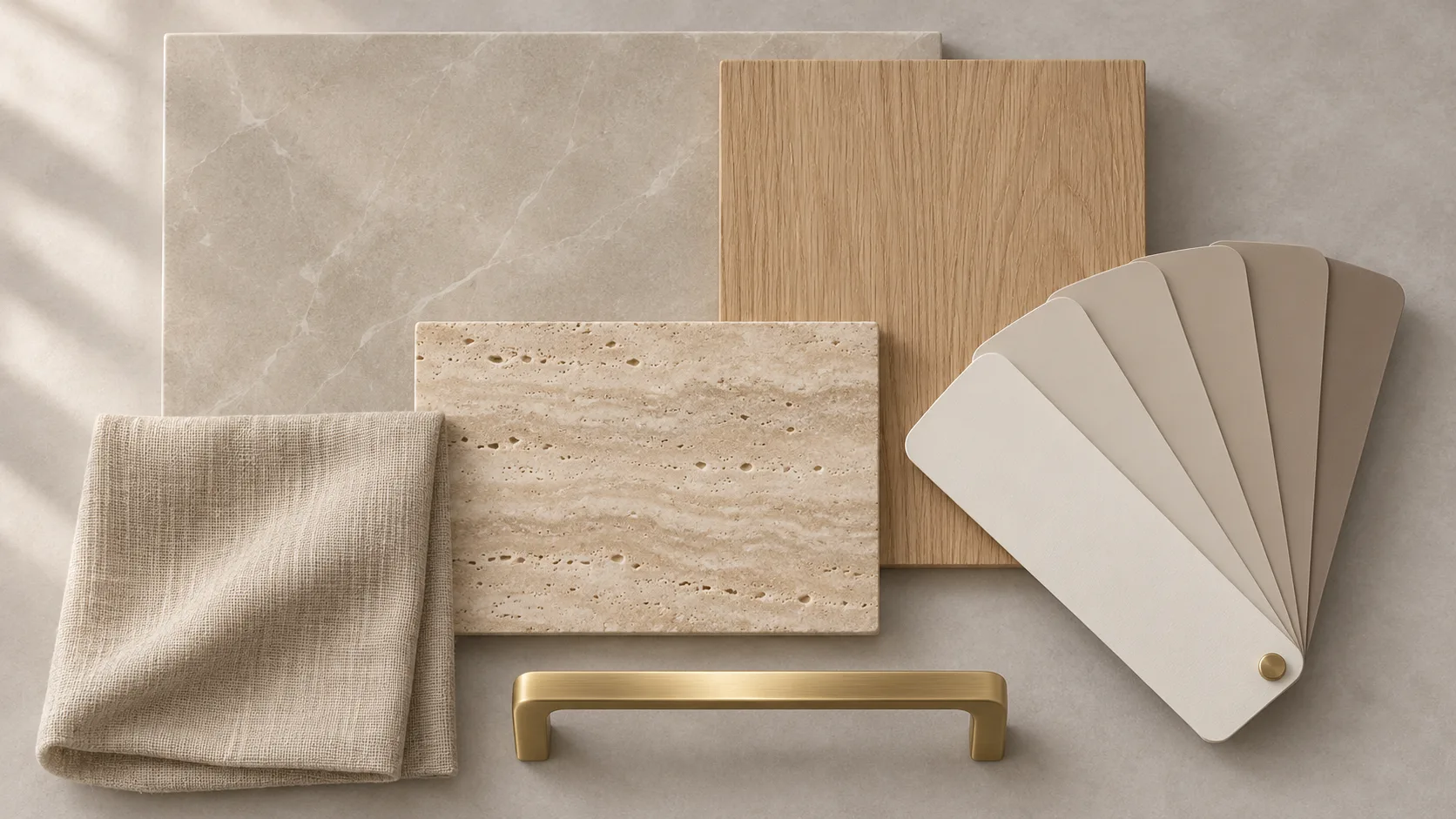
Most finish palettes are not ruined by bad taste. They are ruined by being signed off three weeks too late, after the tiles were ordered and the joinery was cut.
The honest answer: lock 80% of your palette at the end of design development, and 100% before first fix. In a residential renovation that means roughly four to six weeks before demolition starts. If any material is imported, add another eight to twelve weeks. Everything else in this guide is about how to hit those dates without settling for a palette you will regret.
The short answer, by project type
There is no single deadline, because the deadline is set by the longest lead time in your palette, not by the designer’s schedule. Work backwards from the date the first trade needs the material on site.
| Project type | Lock the palette by | Why that date |
|---|---|---|
| Apartment renovation, local stock | 4–6 weeks before demolition | Allows one full revision round plus re-ordering without moving the handover date |
| House build, mixed sourcing | End of design development, before tender | The bill of quantities cannot be priced against an open palette |
| Anything with imported tile, stone or joinery | 8–12 weeks before install, not before order | Production slot + sea freight + customs + inland delivery |
| Hotel or multi-unit residential | Before the mock-up room is signed | The mock-up becomes the contractual benchmark; changing it later triggers variations on every room |
| Kitchen or bathroom only | Before cabinetry is released to production | Cabinet lead times are the critical path; tile can usually be swapped later, cabinets cannot |
Note what those rows have in common. None of them are design milestones. They are all procurement milestones wearing a designer’s clothes.
Why the palette deadline is really a procurement deadline
A late colour decision feels free. It is not. On a 120 m² apartment, swapping the floor tile after the order is placed typically costs you the original order, a re-order at 10–15% waste allowance, and a new production batch — which may not match the sample you approved. That last part is the one that actually hurts: the second batch is a different dye lot, and no amount of goodwill fixes a visible tone break between two rooms.
The same logic runs through every layer of the palette. Stone slabs are sold as bundles from one block; once the block is gone, it is gone. Cabinet doors are sprayed in batches, and a re-spray six weeks later will read as a different white under daylight. Even paint is a batch product, which is why professionals keep the batch code rather than the colour name.
So the useful question is not “when should we be inspired?” It is “what is the longest lead time in this palette, and what date does that put on my signature?”
The five stages, and what must be locked at each
The stage names below follow the RIBA Plan of Work, which is the most widely used stage framework in international project delivery. You do not need to be working under RIBA to use the logic — the sequence is the same on almost any project.
| Stage | What must be locked here | What can still move | Cost of changing later |
|---|---|---|---|
| Concept / brief | Direction only: warm vs cool, matte vs polished, budget band per m² | Everything | None — this is the cheap stage |
| Design development | Base palette, tile format and layout, door style, cabinetry finish family | Exact SKU, grout colour, hardware finish | Low to moderate — drawings only |
| Technical / tender | Signed-off finish schedule, approved samples, spec with tolerances | Accessories, soft furnishings | High — orders are placed against this |
| 建筑 | Nothing new. Only substitutions of equal or better spec | Paint, grout, sealant, trims | Very high — remobilisation, re-order, batch mismatch |
| Handover | Touch-up stock and spare tiles retained | — | Replacement only, often unmatched |
The single most common failure is treating the technical stage as “still designing”. That is the stage where the palette stops being a picture and becomes a purchase order.
What a finish palette actually contains
Designers talk about “the palette” as if it were one decision. In practice it is seven layers with seven different clocks. Lead times below are typical for factory-direct supply from Foshan, including production and sea freight to a major port; add inland delivery and customs clearance on top.
| Layer | Typical lead time | Hard deadline before install | What usually goes wrong |
|---|---|---|---|
| Floor tile and stone | 35–50 days | 8–10 weeks | Layout not set, so quantity is guessed; waste allowance under-calculated on diagonal or herringbone |
| Wall tile and slab | 35–55 days (slab: 45–60) | 7–9 weeks | Book-match pattern approved from a photo rather than the actual slabs |
| Cabinetry and joinery | 45–60 days | 10–12 weeks | Appliance specs arrive after the cabinet order; filler panels improvised on site |
| 台面 | 30–45天 | 8 weeks (after cabinets are templated) | Ordered before templating; overhang and sink cut-out wrong |
| Interior doors | 30–45天 | 9–10 weeks | Wall openings not measured to finished floor level; frames packed out |
| Paint and plaster | Local, days | 2 weeks | Colour approved on a small chip, then applied to a whole wall |
| Hardware, taps, lighting | 25–40 days | 6–8 weeks | Finish family chosen last, then clashes with the door and tap finishes already on site |
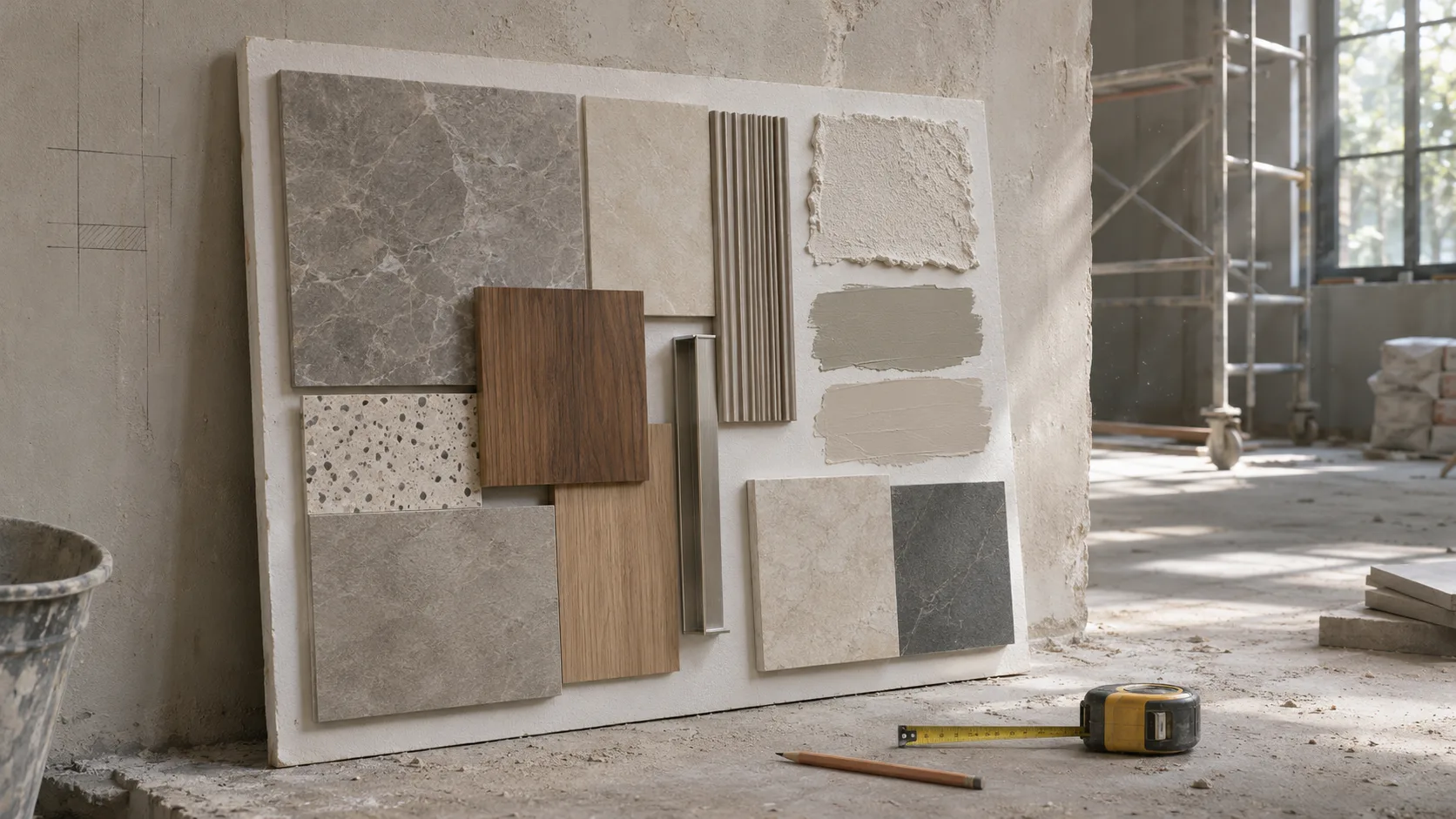
If you only memorise one row, memorise cabinetry. It has the longest lead time, the least flexibility, and it is the layer every other decision hangs off — the countertop is templated from it, the splashback is sized to it, the floor transition lands at its toe kick.
Room by room: which decision actually slips
Across projects, the same room slips for the same reason every time. It is rarely the tile.
| Room | Hard finishes to lock | The decision that slips | Latest sensible date |
|---|---|---|---|
| 浴室 | Floor and wall tile, shower tray or walk-in former, vanity carcass | Waterproofing height and tile trim profile — decided after tiling starts | Before first fix |
| Kitchen | Cabinet finish, worktop, splashback, floor | Appliance model and cut-out dimensions | Before cabinet release |
| Living / dining | Floor, wall treatment, door and skirting profile | Whether the floor runs continuously into the next room | Before screed level is set |
| 卧室 | Floor, wardrobe finish, door | Wardrobe internals, which change the carcass depth | Before wardrobe order |
| Entry / façade | Paving, cladding, external door | Threshold detail between two levels and two materials | Before slab pour |
The bathroom row deserves a note. Because a bathroom is small, people assume it is fast. It is the slowest room in the house to change, because tile, waterproofing, drainage fall and fixture positions are physically interdependent. Once the screed has falls cut into it, the drain position is fixed, and the tile layout follows the drain.
How to build the palette in six passes
This is the part most guides get right in theory and useless in practice, because they describe taste rather than sequence. Do these in order and the palette assembles itself.
1. Start from use, not from colour
A rental lobby, a family bathroom and a hotel suite need different answers before you open a fan deck. Write down who uses the space, how often it is cleaned, whether it takes wheeled traffic, and what the replacement cycle is. Scratch resistance and slip rating eliminate half the palette for you, which is a feature. Those two figures are not marketing copy — they come from standardised test methods such as the ones published by ASTM International, and they are the first thing to ask a supplier for.
2. Set the base in one material family
Pick one dominant material — usually the floor — and let everything else respond to it. A palette reads as deliberate when the largest surface is the calmest. A warm oak floor tolerates a lot of experimentation above it; a busy patterned tile does not. Our flooring guide covers how much visual weight each material carries.
3. Choose the base colour as a value, not a hue
Amateurs choose “greige”. Professionals choose “greige at 65% lightness”. If you fix the value first, you can change hue later without dismantling the scheme — which is exactly the kind of flexibility that saves a project when a tile is discontinued. It is the same principle behind commercial colour systems such as Pantone: a colour is only useful once it has a number you can order again.
4. Add two textures, not two colours
Depth comes from surface, not from more colours. A matte wall, a honed stone and a brushed metal give you three distinct reflections in a monochrome room. This is also why our natural stone guide separates honed, polished and brushed finishes so clearly — the finish changes the material’s behaviour in a room more than its colour does.
5. Introduce contrast at one scale only
Contrast works when it is consistent. If you contrast light against dark at the scale of a whole wall, do not also contrast it at the scale of a tap. Rooms that feel “almost right but restless” almost always have two competing contrast systems.
6. Test under the light that will actually exist
This is the step that separates a palette that works from one that photographs well. Colour rendering is a property of the light source, standardised by the International Commission on Illumination (CIE), and it decides how a beige reads at 8 pm.
Test every sample under two conditions at minimum: 3000K warm light and 4000K neutral light, plus whatever daylight your orientation gives you. A greige that looks expensive at noon can turn pink under 2700K, and a “warm white” paint can go green next to a cool LED. If you are specifying to a client, get the sign-off under both, in writing.
Three tests before you sign anything
- The two-temperature board. Mount every sample on one board and view it at 3000K and 4000K. Anything that changes character dramatically gets flagged, not removed — you just need to know where it is going.
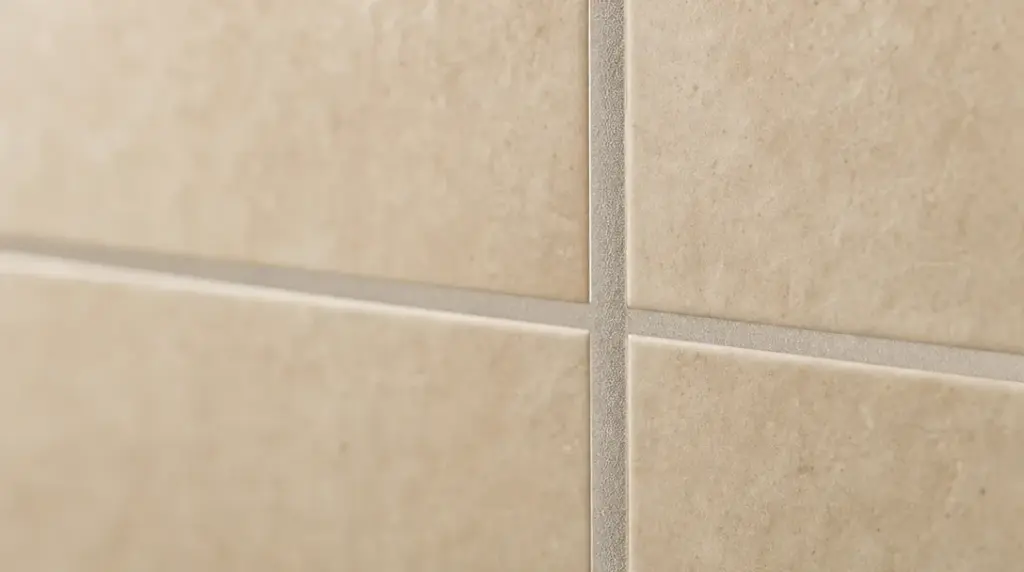
- The 1 m² mock-up. Lay real tile with real grout, real trim and real adhesive thickness. Grout width changes a tile’s appearance more than most people expect, and a 2 mm joint on a 600×1200 tile reads completely differently from a 3 mm joint.
- The phone photo test. Photograph the board, then look at it on a screen the next morning. Cameras exaggerate contrast and cool down neutrals, which is roughly what a client’s memory does too.
What you can still change after the deadline
“Locked” is not absolute. Some things stay cheap to change right up to installation, and knowing which ones buys you room to manoeuvre.
| 项目 | Still changeable? | Window | Penalty |
|---|---|---|---|
| Paint colour | 是的 | Until 1–2 weeks before painting | One extra tin; batch mismatch if part is already painted |
| Grout and sealant colour | 是的 | Until the day of grouting | Negligible — but check against the actual tile, not the sample |
| Hardware and tap finish | Usually | Until 4 weeks before install | Lead time risk on imported finishes |
| Cabinet door style | Sometimes | Before production release | Re-cutting doors; carcass usually unaffected |
| 瓷砖 | Rarely | Before order | Re-order, new batch, tone break, 10–15% waste |
| Stone slab | 不 | Before the block is cut | Different block; book-match impossible |
| Door and window position | 不 | Before framing | Structural |
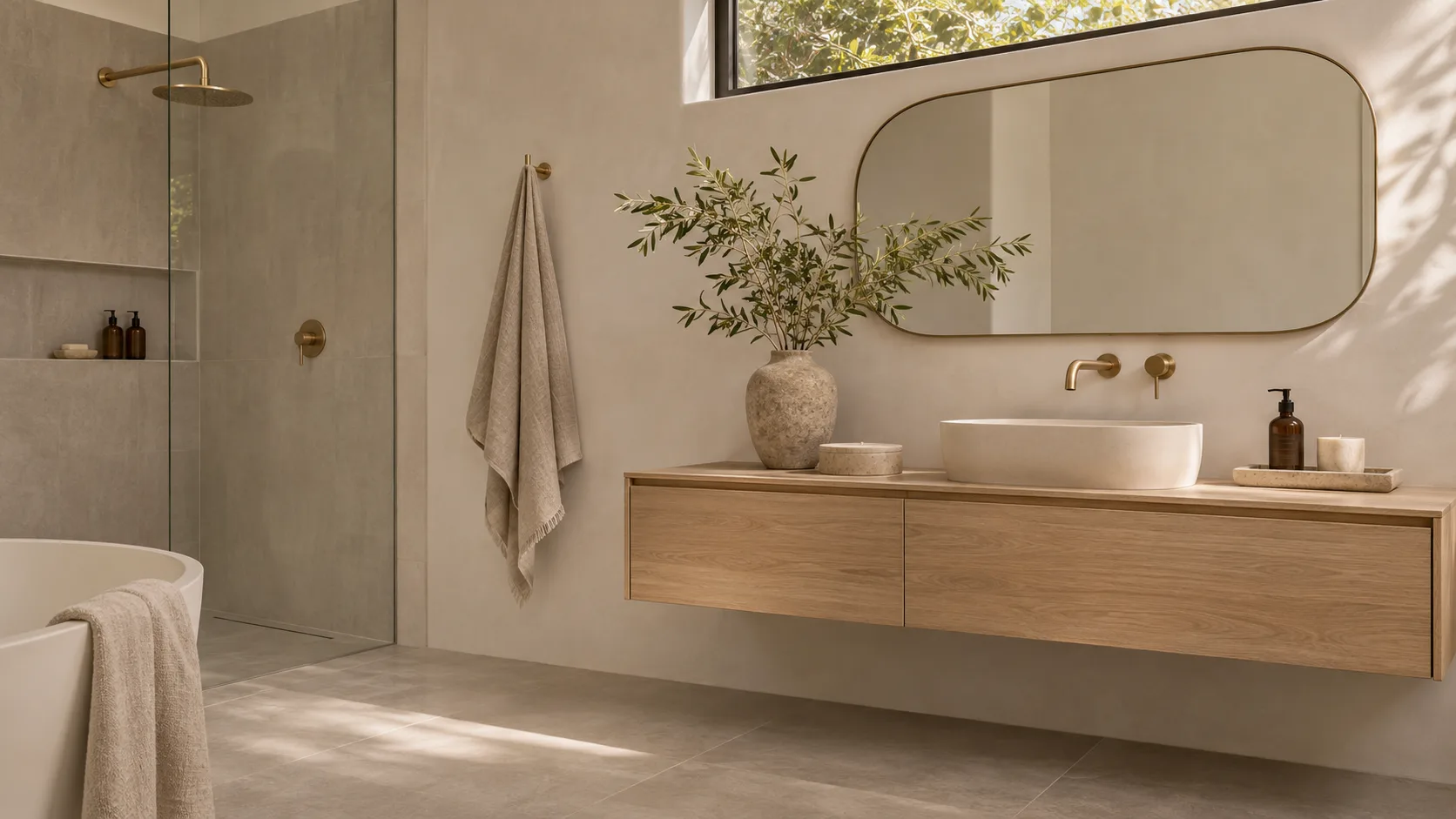
Six sequencing mistakes that cost real money
- Choosing the tap before the tile. The tap is a 10 cm object; the tile is a 30 m² surface. The small object should follow the big one, always.
- Approving from a photo. Screens shift hue, and showroom lighting is not your lighting. Approve from a physical sample under your own conditions.
- Ordering tile before the layout is set. A 600×1200 format laid straight and laid herringbone have different waste factors. Order to the layout, not to the area.
- Leaving grout until the end. Grout is 5% of the visible surface and 40% of the perceived colour. It is also the cheapest thing on site to get right.
- Forgetting the trims. Skirting, shadow gap, tile edge profile and door architrave are the lines your eye follows. They are never in the mood board and always noticed.
- Specifying three whites. Ceiling white, wall white and joinery white in different bases will look like a mistake, because it is one.
If you are buying from a factory rather than a local merchant
Factory-direct changes the timeline, mostly by adding steps that local supply hides inside stock. Four of them decide whether your palette survives the shipment.
- Sample approval, in writing. A signed sample is the only reference in a dispute about tone. Photographs are not a substitute, and “the same as last time” is not a specification.
- Strike-off for anything painted or stained. One approved panel from the actual production line, retained by both sides.
- Dye lot and batch control. Ask for the whole order to be produced in one batch, and confirm it in the PO. If the quantity forces two batches, ask for them to be sequenced by room so the tone break lands at a doorway.
- Buffer stock. Keep 5–10% of tile and one extra door leaf. It is cheaper than a second production run, and it is the only way to repair a bathroom in year four.
This is the practical reason to fix the palette early rather than late: an early, complete specification lets the factory plan one batch. A late, partial one forces split production, and split production is where tone breaks come from. If you are sourcing several categories at once, our supplier guide covers how to consolidate tile, stone, doors and cabinetry into a single shipment window.
For the categories themselves, the specification detail lives in our product guides: porcelain versus ceramic tile, bathroom tile formats and prices, quartz, granite and marble worktops, interior door styles, wall panelling and wainscoting, ,以及 vanity carcass materials.
Questions we get asked most
Can I finalise the palette room by room?
Only if the rooms do not share materials. The moment one tile or one floor runs through several rooms, it becomes a single decision with a single deadline — and it should be ordered as one batch.
How late is too late for a tile change?
After the production order is confirmed, a change is effectively a cancellation plus a new order. Expect to lose the deposit or absorb the stock, and expect a new batch.
Do I need a physical sample if I have a 3D render?
Yes. A render shows composition; it cannot show how a surface behaves under your light. Renders are for agreeing layout, samples are for agreeing finish.
Should the palette be finalised before the lighting design?
They should be finalised together. Finish and light are one decision seen from two sides — a palette signed off before the lighting specification is a palette that will be revisited.
Do I need an interior designer to do this?
No, but the process above is what a designer is actually being paid to run. If you do appoint one, membership of a professional body such as the American Society of Interior Designers is a reasonable quality filter — more useful than a portfolio, because it implies a documented approval process rather than just good taste.
What if the client wants to change something mid-build?
Price it in time, not just money. Ask which trade has to return, whether the material needs re-ordering, and whether the new item will match the existing batch. Most clients withdraw the request once the re-order date is on the table.
The takeaway
Finalise the palette at the end of design development, and treat that date as a procurement date. Lock the long-lead layers first — cabinetry, stone, tile, doors — and leave paint, grout and hardware open as long as you can, because they are cheap to change and they are the ones that benefit from seeing the room built.
Then test it properly: two colour temperatures, a real 1 m² mock-up, and a physical board rather than a screen. Do that, and the palette stops being a risk item on the programme and starts being the part of the project that makes everything else look considered.
If you are specifying for a project and want the finish schedule priced as one package — tile, stone, doors, cabinetry and sanitary ware from a single factory group — FenSo大楼 quotes against a schedule rather than a catalogue, with batch control confirmed in the PO.
 English
 German
 Chinese
 Arabic
 French
 Spanish
 Turkish
 Russian
 Italian